How to Solve PSA MD1CS003 ECU Bench Locked with Foxflash
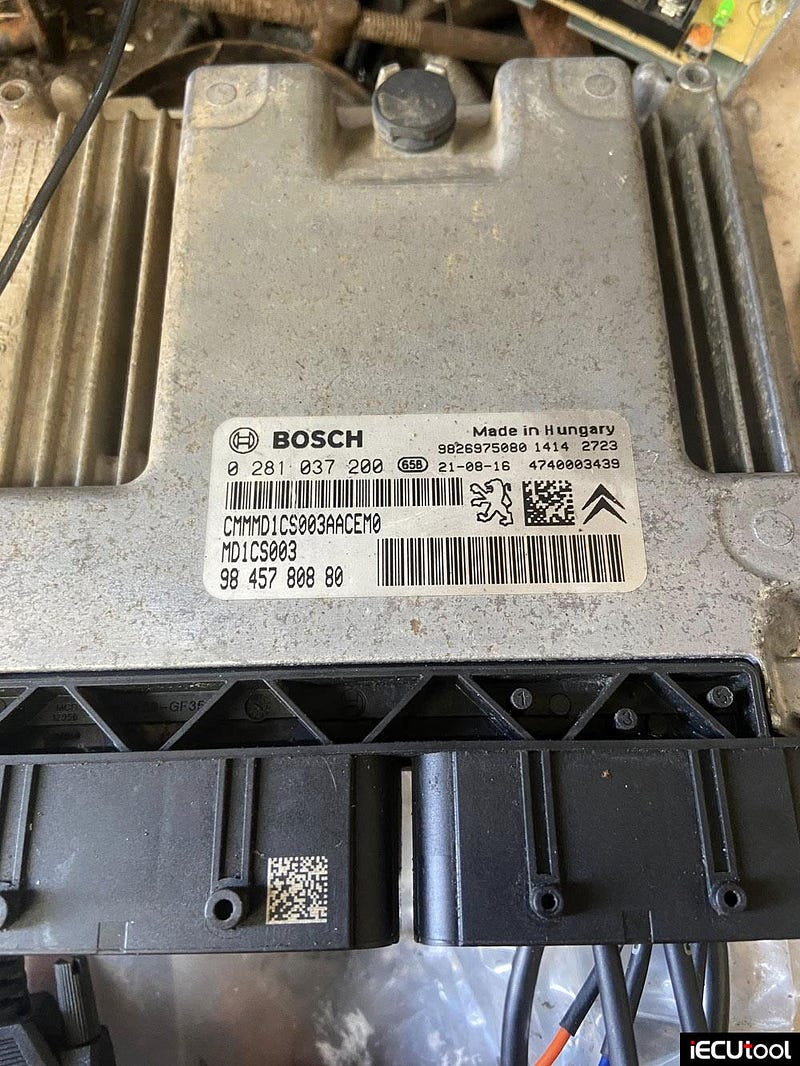
Problem: Tried to read Peugeot Bosch MD1CS003 ECU 0281037200 with FoxFlash programmer but failed. Error SK2 bench locked.
Can Autotuner or Hexprog2 do them?

Solution:
They are not locked till around 2021. Done a lot of them with foxflash 2018–2021, this one is from 2022 and is locked.
0281 034 708 OK
0281 034 826 OK
0281 035 332 OK
0281 035 365
OK
0281 035 366 OK
0281 036 205 OK
0281 037 101 OK
0281 037 198 NOT
POSSIBLE
0281 037 200 NOT POSSIBLE
037–039 are locked.
Foxflash, Autotuner, Flex etc cannot read if locked.
Only v2flasher after 2020. Vf2 can unlock on lab and after that can read/write.
Tips for Peugeot MEVD17.4.4 ECU Reading and Writing Foxflash
Question:
I just bought FoxFlash to read my MEVD 17.4.4 Peugeot 308 GT
205 hp and I need some advice
Is 12V enough or is 14V better?
Once the
play is done I edit the file with WinOLS 4.7 I have a mappack and do I have to
do something else before I write the file so my car can start
smoothly?


Here is the clue.
12.5V to connect directly to the car, outside it’s better to prefer 14 volts or 13.5V.
You write that’s all, but let the tool do the checksum calculation.
Fox automatically does the tprot off automatically. It’s automatic!!
Must do the trpot off otherwise it only starts once.
Foxflash or Hextag II: Which ECU Programmer Should You Use
What’s the difference between Foxflash and Hextag II (Hextag2) programmer?
Here comes the brief comparison.

Hextag II (HexProg II)
The Hextag II, developed by Microtronik, is a next-generation ECU/TCU cloning and chip tuning tool that builds upon the capabilities of its predecessor, the original HexTag/HexProg. It is designed for professionals working on a wide range of vehicles, with a strong focus on BMW and other premium brands like Porsche, Audi, and Volkswagen. The Hextag II is known for its safety, speed, and ability to perform complex tasks such as reading/writing CAS4/CAS4+ modules without desoldering, mileage resets, and key programming. It supports a variety of protocols, including OBD, Bench, Boot, and BDM/JTAG, and is equipped with advanced hardware to handle high-voltage programming requirements.
The Foxflash ECU Programmer is a versatile tool designed for tuners and automotive professionals, offering extensive support for ECU and TCU programming across a wide range of vehicles, including cars, trucks, tractors, boats, and motorcycles. Foxflash is noted for its full protocol activation, offline/online functionality, and robust firmware updates.Foxflash is marketed as a reliable, all-in-one solution for reading, writing, and cloning ECUs/TCUs, with a focus on user-friendly operation and comprehensive protocol coverage.
1. Functionality and Features
Hextag II:
Core Functions: Specializes in ECU/TCU cloning, chip tuning, BDM (Background Debug Mode), mileage reset, key programming, and body control module (BCM) repair. It excels in tasks like reading/writing BMW CAS4/CAS4+ modules, Porsche BCMs, and other complex ECUs without desoldering components.
Additional Features: Supports advanced functions like ISN (Individual Serial Number) reading/writing for BMW MDG1 ECUs, FRM (Footwell Module) repair, and key reset for brands like Audi, BMW, MINI, Porsche, Nissan, Toyota, Fiat, and Renault. It also handles EEPROM resets for dashboards (e.g., M35080, M35160) in seconds.
Modes: Supports OBD, Bench, Boot, and BDM/JTAG protocols, with a focus on safe and fast operations. It can handle high-voltage programming (17–24V) for specific ECUs and up to 34V for 24V vehicle OBD systems without additional adapters.
Safety: Emphasizes safety, with claims of being the "safest tool in the world" for operations like CAS4/CAS4+ programming, avoiding EEPROM or D-Flash corruption.
Foxflash:
Core Functions: Focuses on ECU/TCU cloning and chip tuning, supporting a broad range of vehicles (cars, trucks, tractors, boats, motorcycles). It is designed for reading/writing operations across hundreds of ECU/TCU manufacturers, with protocols like OBD, Bench, Boot, and BDM/JTAG.
Additional Features: Offers features like checksum correction, DPF/EGR/AdBlue removal, and stage tuning. It has been tested successfully on various ECUs, such as Bosch EDC16, EDC17, and Siemens SID series, with positive user feedback for tasks like IMMO OFF and cloning.
Modes: Supports OBD, Bench, Boot, and BDM/JTAG, with a strong emphasis on full protocol activation in its single, full-version package.
Safety: Superior stability compared to competitors like KT200, with better-quality BOM (Bill of Materials) and PCB (Printed Circuit Board), reducing the risk of bricking ECUs.
Comparison:
Hextag II has a broader scope of specialized functions, particularly for BMW and premium brands, including key programming and module repairs (e.g., FRM, CAS). Foxflash, while versatile, focuses more on universal ECU/TCU programming across diverse vehicle types, with fewer specialized features like key programming or module repair.
2. Compatibility and Vehicle Coverage
Hextag II:
Strong focus on BMW, MINI, Porsche, Audi,
Volkswagen, and other premium brands. It supports a wide range of ECUs,
including Bosch MDG1, and modules like CAS4/CAS4+, Porsche BCM, JLR KVM, and
Mercedes EZS.
Also supports non-premium brands for tasks like mileage reset and key programming (e.g., Nissan, Toyota, Fiat, Renault).
Can read/write ECUs without opening the cover, enhancing compatibility with complex systems like BMW MDG1 DME/DDE.
Hextag can do SID321, DCM7.1A/B via OBD, DCM6.2V boot for cloning or if VR not on server, Simos 18–18.6 OBD2 VR, Valeo V56, 56.1 boot, Simos 11, 12, 16 VR read/write, SID310 MB Renault OBD2 without unlock. Foxflash cannot.
Foxflash:
Offers extensive compatibility across a wide
range of vehicles, including cars, trucks, tractors, boats, and motorcycles. It
supports hundreds of ECU/TCU manufacturers, covering protocols like Bosch EDC16,
EDC17, ME7.5, Siemens SID, and Denso.
Excels in universal applications, with tested support for specific models like BMW X3, Mercedes W204, VW Golf, and Nissan Juke.
Comparison:
Foxflash has broader vehicle coverage, making
it ideal for professionals working on diverse fleets. Hextag II is more
specialized, particularly for BMW and premium brands, but less versatile for
non-premium or heavy-duty vehicles.
3. Hardware and Software
Hextag II:
Hardware: Features advanced hardware with more
I/O pins, support for high-voltage programming (17–24V for ECUs, up to 34V for
OBD), and no need for external adapters. It’s designed for durability and
future-proofing with additional functions.
Software: Uses the dedicated HexProg II Tuner software, which requires registration and login credentials. It operates offline for most functions, with server-based diagrams for certain tasks. The software is user-friendly, with live support via chat, email, or Skype.
Updates:
Regular updates are available, with existing HexTag/HexProg users
able to upgrade to Hextag II for $465 and transfer licenses for free.
Foxflash:
Hardware: Equipped with high-quality BOM and
PCB, claimed to be superior to competitors like KT200. It supports only online
operation, with robust servers for VR (Virtual Reading) supply.
Software:
Uses Foxflash Manager, a distinct software from competitors,
with regular firmware updates to enhance stability and protocol support. It
supports auto-checksum and is compatible with Windows 7, 8, 8.1, 10, and 11.
Updates: regular update fix bugs
Comparison:
Hextag II’s hardware is optimized for high-voltage and specialized tasks, while Foxflash emphasizes stability and universal compatibility. Both have user-friendly software, but Hextag II’s offline capability and live support give it an edge for professionals needing immediate assistance.
4. Connectivity (Online/Offline)
Hextag II:
Primarily operates offline, with server-based diagrams for specific tasks. This reduces dependency on internet connectivity, making it suitable for remote or fieldwork environments.
Foxflash:
Supports online mode only, requires an internet
connection.
Comparison:
Hextag II is better for offline work.
5. Pricing
Hextag II: Starts at $575 for the Basic Set, with no annual fees or hidden charges. Existing HexTag/HexProg users can upgrade for $465, with free license transfer.
Foxflash:
Priced at approximately $675 for the full
version, which is cheaper than some competitors’ full versions.
Comparison:
Hextag II is slightly cheaper for new users,
and its upgrade path is cost-effective for existing Microtronik customers.
Foxflash’s pricing is competitive for its full protocol coverage.
6. User Feedback and Reliability
Hextag
II:
Users praise its speed, safety, and reliability, particularly
for BMW CAS4/CAS4+ and Porsche BCM tasks. Reviews highlight successful FRM
repairs, key resets, and stable operation, with comments like "100% recommended"
and "works like a charm."
Foxflash:
Receives positive feedback for its stability
and speed in reading/writing ECUs, with successful tests on models like BMW X3,
VW Golf, and Mercedes W204.
Pros and Cons
Hextag II
Pros:
Specialized for BMW
and premium brands, with advanced features like key programming and module
repair.
Safe and fast operations, particularly for CAS4/CAS4+ and
high-voltage ECUs.
Offline functionality, ideal for remote
work.
Comprehensive live support options.
Cost-effective upgrade path for
existing users.
Cons:
More expensive for new users compared to some
universal tools.
Less versatile for non-premium or heavy-duty vehicles.
Foxflash
Pros:
Broad vehicle
coverage, including cars, trucks, tractors, boats, and motorcycles.
Full
protocol activation in a single version, with free online updates.
Supports
both online and offline modes.
Two-year warranty and strong technical
support.
Competitive pricing for full version.
Cons:
Lacks specialized features like module
repair.
Only support online mode.
No more protocol updates.
Requires
modern laptop.
Which Tool Should You Choose?
Better get both.
Hextag2 its mainly for bench works and yes good and stable tool, but they need to keep developing new protocols and a hugh improve on obd protocols.
Foxflash works with diverse range of vehicles, including non-premium and heavy-duty applications. It is a cost-effective, all-in-one tool with full protocol support.
Foxflash Supports Mercedes Benz EDC16CP36 via OBD & Bench
Foxflash read Mercedes Benz Bosch EDC16CP36 ECU via OBD or Bench?
Both OBD and bench mode work fine.
For example:
MERCEDES-BENZ S 350 CDI 235HP 2008
EGR/Swirl Flaps OFF
EDC16CP36 on
Bench with Foxflash. Read ok, write ok, checksum with foxflash.
Over OBD was also read and write.
But on this ecu for some functions you can do them only on bench/boot, because some of the map sectors are not transferable over OBD️.
Bench mode:


OBD mode:


Foxflash VR Read Write for VW Polo GTI 1.8TSI Simos 18.1
Here comes the new user feedback from one of the Foxflash users:
VW Polo GTI 2017 1.8TSI 192HP
Simos 18.1 ECU.
OBD VR read ok.
Hit "Read" and get vr file online.
OBD Write
ok.
Checksum correction with foxflash.
Simos 18.1 VR reading need luck.
There is no support for Golf 7 gti
engine.
golf mk7 vr was no problem, I went to do a customers mk7.5 — same
ECU — no VR available. Had to read and write in boot mode.

